Yazının tercümesi için Bkz. FIParanoia
This is FIP; the silent killer that doesn’t discriminate.
This is my story:
I was brought up with cats, in fact it was my desperation to get hold of a cat that was the inducement for me walking at 10 months. We ever only had one cat while I was growing up but that cat was my world. He passed on from old age and there was a gap before I become a proud cat mommy again. I was just married and one of my husband’s family members had bought herself a Persian, only to discover that she was highly allergic to cats. Remo, as he was named, was unceremoniously dumped on my doorstep. He was only three months old and he quickly became my baby. To keep him company we got a little black female Persian, Joebies, and together they ruled the roost. Both were indoors only cats as we lived in a block of flats in the centre of town. When Remo was five I fell pregnant and had a daughter. The flat became too small and so we went house hunting. Within months we moved twice, to a temporary flat while the paperwork went through, and finally into our own home. The house was fairly dilapidated so we set about doing renovations. It was a very stressful period for the cats and Remo started losing weight. I put it down to him being active; since we had moved in I had allowed him access to the garden. He had a few accidents – poo’ing inappropriately but I thought he was only seeking attention. Then a few months down the line our neighbour called, she’d found a cat in her yard that her dogs had got hold of. I rushed over to discover it was Remo. My heart stopped. We rushed him to the vet but luckily he was only in a state of shock, so much so he was temporarily paralysed. He stayed under vet care for a week and came home. He was very week and just slept all the time. Five days later he collapsed and before we could get him to the vet he had passed away. My vet was just as devastated as we were. We left Remo with him and unbeknown to us he performed a necropsy on Remo. He was so baffled by what had happened that he needed to know what the problem had been. He contacted us to advise that Remo had feline infectious peritonitis and that his liver and kidneys had failed. At the time I didn’t know if it was wet or dry FIP, but due to my work in the FIP world I now know that Remo had dry FIP. At the time I was shattered and I didn’t really understand the significance of feline infectious peritonitis so we moved on. Unfortunately we lost Joebies soon after; she pined so much for Remo and one day she just disappeared. That was heart breaking.

It was a while before I felt ready to adopt another cat. My daughter had inherited my love for cats and we eventually broke down and got her a kitten. That was in December 2001; she’d been born on the 31st October 2001. Bagheera was a chocolate tortoiseshell, a moggie with the most lovable personality. As a result of my experience with Remo I made sure she became an indoor only cat. She was a very content little kitten. The true queen bee who ruled our home. When she was three we happened to find a stray little kitten in our yard. He was a friendly ginger tom and so we decided to bring him indoors. Baggie was very nose out of joint and she battled to adapt to the new family member. She never accepted him; deigning to only tolerate his presence. All went well; my cats were happy and healthy and then in the beginning of 2011 I decided to expand my family of cats and I adopted two little boys, Turbo Mud Ponzonby and Bungee Sponge Carruthers. Bungee was a very sickly kitten. He had terrible diarrhoea, sneezing and watery eyes. But I thought it was just the change in environment and I nursed him constantly for three months. Baggie had strangely accepted the two boys and was fairly fond of them. 2011 was a bad year, filled with stress and emotional turmoil, and I am sure Bagheera picked up on all this. My daughter was writing exams and one day we realised Baggie had not come through to the kitchen. We went in search of her and found her curled up on my daughter’s bed. She was severely dehydrated and was purring up a storm. I now know why FIP is called the “purring disease”. We rushed her to the vet and he immediately set her up on a drip and started medication. We had noticed her tummy getting bigger over the months but ignorance is bliss – we put it down to her age, her inactivity and her love for food. The vet did not want to commit until he had managed to draw fluid off her abdomen but she rallied around within a day. She was perky when we visited her and was head booping us and chatting away. Two day later she started to slip and the vet then pulled me aside and explained that the fluid he had drawn had come back as positive for FIP. It was a huge blow. He tried to drain off more fluid but with no luck and she lost the will to live. We made the very sad decision to help her over the bridge four days after we had rushed her to the vet. I had no inclination of her condition – the only pointers were a swollen belly, lethargy and dehydration with a fever. It happened very quickly. It set my daughter back terribly as Baggie had been her cat and had helped her through a very traumatic period.

My daughter did not feel ready to adopt; she was so distraught. Once again I did not put two and two together. All I knew was that we had lost a very precious member of our family and the name FIP was pushed to the back of my mind. At that point I did not even think of Remo and what had happened with him. Shortly after Bagheera died we needed to visit the vet. When I went in they had a little kitten they were hand feeding. She was only ten days old, which meant she’d been born the day Baggie had died or at least very shortly thereafter. She was the tiniest, scruffiest little thing ever. Someone had rescued her out a refuse bin in an industrial area. Her mother must have been a feral cat and unfortunately, black cats come with a lot of superstition and clearly they had meant to kill this little kitten. My daughter happened to come into the vet’s consulting room and her and the little kitten just connected. She asked if we could please adopt her when she was old enough. We agreed and then visited her every day until she was ready to come home.
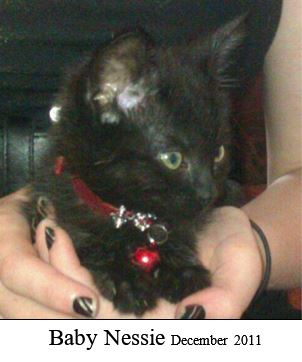
The vet had named her Phyliis (in Afrikaans, one of our official languages vullis – pronounced Phyllis – means rubbish) but she was such a spunky, feisty kitten we decided the name Wednesday Addams suited her much better. Little Wednesday came home the beginning of December and from the get go she took over the house. All three boys, including my big huge lump Tiger (orange tabby we’d homed from our garden), just fell in love with her. She was so much cat that her name eventually went from just Wednesday Addams to Wednesday Nox Bellatrix Temperance Amelia Addams (named after strong women!) but nicknamed Nessie. Nessie suited her – she was tiny and we could call her Nessie Nox, Nessie Monster, NesQuick or whatever her personality for the day was. She was always small, at her heaviest she was only 3 kgs (6.6 lbs) and she always had a very weepy eye but other than that she was a perfect, healthy kitten.
We often travelled and we had a cat sitter look after our four. That year. 2013, we once again went away for a while. It was mid July and all the cats were fine. My in laws, who stayed with us on the property, had been looking after some feral cats in the yard and although we asked them to discourage it they had made beds for them on the patios. We were away for six days and when we returned Nessie felt a whole lot lighter. When I weighed her she was 2.5 kgs (5.5 lbs). She was a tad hot but otherwise she was perky enough. I immediately took her to the vet who expressed concern at her weight loss. She suggested a number of reasons such as diabetes, FIV, FeLV or stress. While we were there she ran the tests for diabetes, FIV and FeLV, checked her for parasites and checked her urine. Everything was perfect. So we thought it could possibly be stress and we bought her a stress collar. The vet still recommended we do a full blood panel as there were some things she wanted to rule out. My appointment had been mid morning but four hours later we had to rush Nessie back as she had gone into seizures. It was a horrifying and very scary experience. The vet tried to draw blood then but Nessie was just too distraught so we postponed it. She gave her an injection to counter the seizures and a broad-based antibiotic.
Nessie rallied for a week but her weight would just not pick up. Then we started noticing small quivers going through her body, the inability to jump, the unsteadiness on her feet and then her weight started to drop. Within a few days she lost a further 250 g (0.5 lbs) and she lost her appetite and became lethargic. She took to sleeping for long extended periods of time, totally out of character. We took her into the vet and she stayed overnight. They drew blood and sent it off to the lab. When we visited her in the evening the veterinary nurses told us she had been exposed to panleukopenia. There was an epidemic within our area and although Nessie had been vaccinated against it she still contracted it; most likely from the ferals that had been in our yard. The initial blood test had shown an elevated protein count and the vet on closer examination had found swollen lymph glands. That was when she told us she suspected FIP. The past came rushing back – Remo, Bagheera, Nessie’s small stature, the ferals. Nessie was very weak, she was now weighing 2.2kg (4.8 lbs) and although she was hungry she just couldn’t eat. The blood tests were positive for jaundice and she had non-regenative anemia.
The vet had started her on a heavy protocol of drugs but unfortunately we did not have access to Polyprenal Immunostimulant (PI) in South Africa. I doubt if it would have worked as Nessie went downhill so quickly. To confirm her suspicions the vet ran a further series of blood tests: a Serum Protein Electrophoresis which indicated a low Alpha:Globulin ratio which is indicative of FIP. On closer examination we also noted that Nessie’s right eye was smaller and that there were marks developing on the iris. We took her home to decide the best course of action. Thursday she was not too bad; had a little bit to eat in the morning but then by the afternoon she stopped eating. She was battling to drink water as well; she become very disorientated and unco-ordinated with her tongue. It was so heart breaking to see this once healthy kitten be so helpless. By Friday her condition was severe. I managed to syringe feed her but it was apparent she was waning fast. Nessie was a cat who never got sick but the last two weeks she had been bringing up a clear, mucousy fluid with froth in it. On Friday night, she was violently ill and for the first time she looked anxious.

We sat vigil with her through the night and it became apparent that she was declining by the hour. Her legs were going into spasm and she would shake her head. She was sitting all bunched up as if she were in pain. It was traumatic to experience what this disease can do to a robust, full of life cat. Saturday morning we made the decision to help her cross the bridge. We had a sedative, which we gave her an hour before taking her to the vet. For most of the morning we sat with her, chatting to her about all the wonderful things we’d experienced and how much she had meant to us. Each of the boys sat with her the whole time too, touching noses with her and giving her a lick or two. My daughter then took her to all her favourite haunts around the house. On the way to the vet she reached up and licked my daughter on her cheek. Nessie was never a licky type of cat but I think it was her way of giving a good-bye kiss. We were with her at the vet, where I also got a kiss, and right through the procedure. The whole time she looked at my daughter, never once taking her eyes off her face. The love and bond they shared was beyond compare. We still cannot deal with the trauma of this disease that ripped this precious little one form our lives. It is a silent killer, sneaking up and taking those that are most precious away.
It is only with Nessie that I started to understand the horror of FIP and to research it fully. I joined a support group on both facebook and these people
In 2016, together with two amazing ladies, Fabienne Marie and Bobbi Rossell, we decided to create our own page and website. FIP Advisory and Care Group and fipcaregroup.com came into being. Together we will work at trying to further knowledge of this disease, bring awareness to all and help to find a cure or at the very least, an effective treatment. There have been some successes in the field with the drug PI, used individually or in combination. The key it seems is early detection. Nessie was too far along for any medication to work. FIP also seems to act quicker in some cases than others. It is a disease that even the specialists in the field are in a quandary over. The stats say that it is usually cats under two (and over 12) who are more susceptible yet two of mine were in the band least at risk; the stats say pedigrees such as Persian, Sphynx & Birman are higher at risk yet again two of mine were not in a risk category. More males are affected than females yet I had two females and one male be affected by this disease. My vet has been very sympathetic through all this and it is important that you have a vet who is understanding and passionate. I have shared much of my insight and the documents I received with her. I also strongly believe in offering support via our facebook page FIP Advisory and Care Group – those who join the page are usually distraught and torn apart emotionally and need support and courage to deal with this disease. There is a lot of reading material available but at the end of the day nothing means so much as the human touch. That is what has helped. We grieve for Nessie more now than when she left for the bridge. The grief process is what is the worst to deal with – initially the shock numbs you but as the reality becomes apparent grief sets in, the grief of having a precious member of the family taken away when they had so much of life still left to live. What has really hit home is that FIP somehow affects the most special cats; those with that special quality. became my FIP family.
In 2018 a fellow FIP Angel parent, Maria Bonino, founded the global initiative EndFIP® together with the Luca Fund for FIP Research. This has been a ground breaking endeavour bringing together FIP Awareness and Education under one roof. Both the webpage and Facebook page offer people an insight into this disease, a safe place to grieve and to remember their beautiful FIP Angels (EndFIP® Invictus). Both groups belief in a morally and ethically placed end to FIP and in compassion and insight into helping people who are touched by this devastating disease.
In Memory Our Beloved Girls - Bagheera and Wednesday

Darkness gripped our world today,
our little girl was taken away,
We watched her fading into dusk,
and whispered to her "It’s time to rest."
Our hearts crumbled as we watched her go,
but we just couldn’t let her suffer so.

We kissed her head, buried our faces in her side,
whispered goodbye and a part of us died.
May heavens arms hold you, softly our love,
until we can hold you in Heaven above.

WE will love you always and keep your spirit near
You can access information at:
www.fipcaregroup.com

www.fiptreatmentnews.com

www.endfip.com

www.lucafundforfip.com


www.facebook.com/groups/fipcaregroup/

www.facebook.com/groups/EndFIP/

www.facebook.com/groups/EndFIPInvictus/

www.facebook.com/LucaFund/